
Laundry as abstraction
What might have been sterile and pedestrian a decade ago is comfort today.

I was with my girlfriends last week and one of them arrived smelling like she had rolled out of a tumble dryer full of fabric softener and soap flakes. So very freshly laundered.
‘Which detergent are you using?’ I asked leaning in to imbibe the fresh, clean and soapy halo around the sleeve of her jumper and feeling slightly invasive by my asking. The fragrance of her detergent made my Dr Beckman laundry sheets I was trialling feel like a watercolour.
She pointed at our mutual friend and said, “I smelt it on Lucy and asked her the same. That’s how I found it.”
The next day I was up at the supermarket on a special trip to purchase the said Persil Douceur Almond. I stripped my bedding and began washing what was even clean washing afresh. I too wanted to smell like fresh laundry and to lie in it also.
When I fell into my fresh laundered sheets that evening I felt supported. I could close my eyes and go to sleep with a feeling I had been placed in a gentle cul de sac of safety and comfort.
Sadly the fragrance soon faded out after a day or so. I wanted more. I went back to the supermarket shelves and studied the laundry section in a way I had never before. Lenor scent booster beads stood out promising me a longer stay of fragrance. That is, “a boost of non-stop freshness for up to 12 weeks in storage".
But then I had to leave for London. The research remained in progress.
Perfume and laundry scent
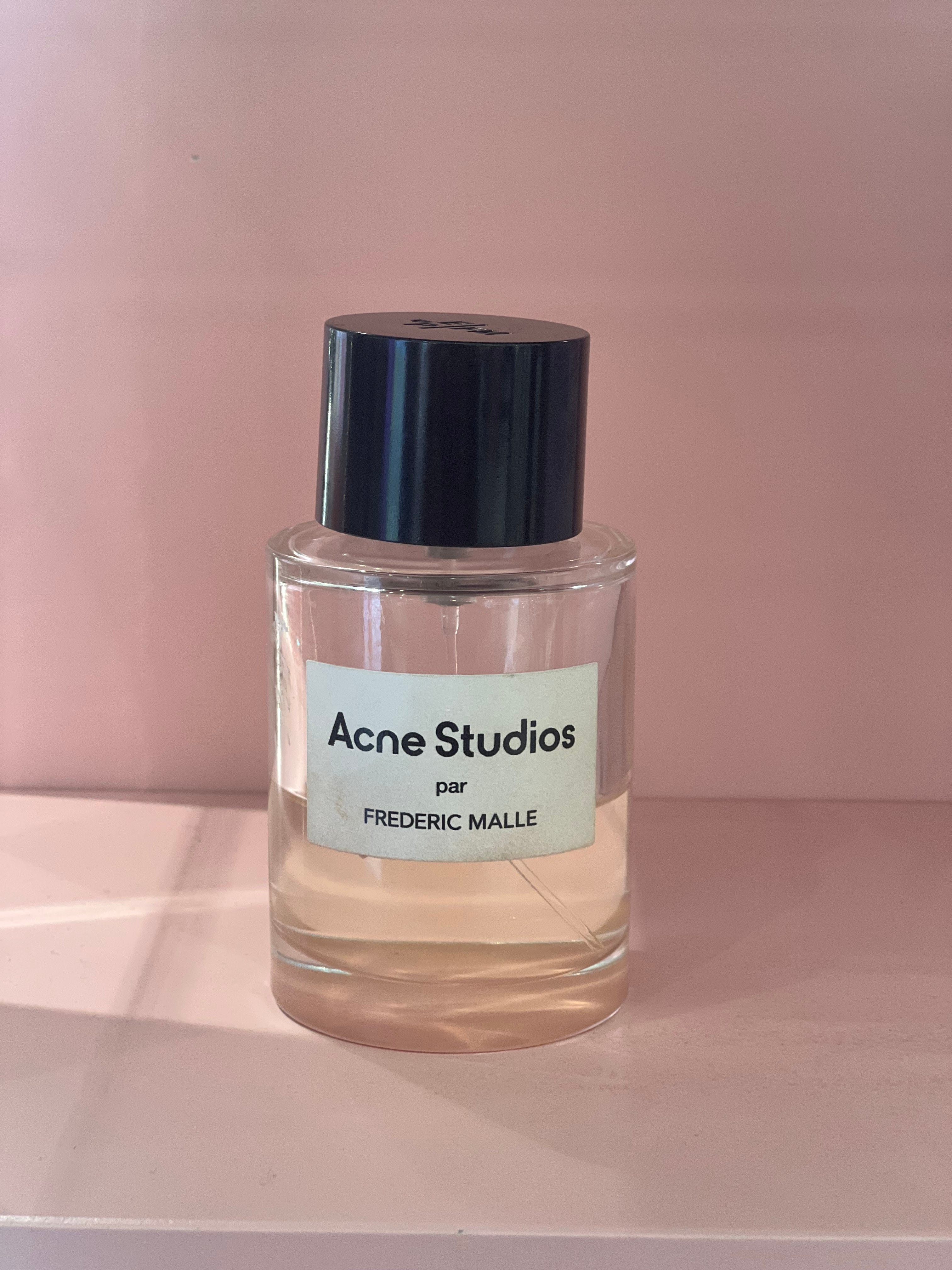
In London I wandered into SpaceNK on an outing with my daughter. I went over to Frederik Malle x Acne and as soon as I took my wrist to my nose after the first spray, I started to go in a spin. A frenetic spin which can happen in the final 2 minutes of a washing machine’s load. My wrist was almost up my nostrils as the opening was so unexpected. It was a synthetic bomb of aldehyde. A fizzing, soapy laundry party.
I remember months before in the summer trying the same scent with Costanza of nunotes one day as we were browsing and I liked it but did not get the same blow out. My nose is changing. It’s nerve endings are growing I am sure. Where else could this soapy laundry antenna coming from?
Laundry scent raising the game (if the context is right)
Interestingly in a double-blind field experiment in a second-hand clothing store, customers encountered either a fresh linen scent, a vanilla sandalwood scent (pleasant but unrelated), or no added scent.
The fresh linen scent, which was chosen for its semantic link to clean clothing, almost doubled customer spending compared to both control conditions while other variables such as weather or day of the week had no effect.
Results suggested that cognitive priming, that is the scent reinforcing the idea of cleanliness and product value, was the main driver.
Scents against the scourge
I segue to the movie Hamnet. It’s portrayal of life during the outbreak to the modern plague, coupled with the lack of cleaning products we have today in the Shakespearian home, presented an oppositional move away from cleanliness as we know it in the modern sense. There was the same dress worn every day, the long strands of unwashed hair plastered to sweat on a face that made the glass skin of today look alien. There was the lying in dirt in a forest and returning home to prepare food with the same dirt under fingernails. There was that stinky looking thick leather glove from which a falcon eats raw flesh.
As I sat in the cinema I touched my Zara rotation denim and smiled at Jessie Buckley wearing that same cotton burgundy dress again, and again and again.
Yet I loved watching the herbs she prepared to clean the Shakespearean domestic home with. An interview with Maggie O’Farrell who co-wrote the script and was author of the book Hamnet actually cultivated an Elizabethan medicinal herb garden to understand the daily life and, specifically, the labor-intensive practices of 16th-century herbalism. And what was the fragrance equivalent to the semantics around cleanliness back in the time of Shakespeare?
Roger Fenton’s response to the 1603 plague, “A Perfume Against the Noisome Pestilence” creates a metaphorical aroma in his writing, at that time as a best defense against the pestilence. A sweet perfume. An imagined scent that stood for safety, order, and divine reassurance in the face of invisible threat.
Is that why I seek out the sweet smell of fresh laundry today? As Fenton sought defense and a divine reassurance, I too am looking for the safety and security of clean and laundered washing while the Epstein diaries roll out and the tectonic plates of the current world order rub against each other like horns rutting.
Sweetness has never been neutral. It has always carried the weight of goodness, safety, and moral order and the fear of what happens when that sweetness turns.
I will leave you with part of Sonnet 94 by William Shakespeare himself who uses scent as a metaphor for morality.
“The summer’s flower is to the summer sweet,
Though to itself it only live and die,
But if that flower with base infection meet,
The basest weed outbraves his dignity:
For sweetest things turn sourest by their deeds;
Lilies that fester smell far worse than weeds.”
Sonnet 94, William Shakespeare
_____
Sources:
de Groot, J. H. B. (2021). Smells in sustainable environments: The scented Silk Road to spending. Frontiers in Psychology, 12, 718279. https://doi.org/10.3389/fpsyg.2021.718279
Fenton, R. (1603). A perfume against the noisome pestilence prescribed by Moses unto Aaron. Num. 16.46. London: R. R. for William Aspley. Retrieved from https://name.umdl.umich.edu/A00667.0001.001
Shakespeare, W. (1609). Sonnet 94. In Shakespeare’s Sonnets.
I love a laundry scent as well!
The leap from Persil to plague defense is unexpectedly sharp. That cognitive priming study backs up what the essay intuits, clean scents literally reframe value perception. I went through a similarthing with a specific hand soap during 2020 that became weirdly totemic for me as a safety anchor.